



- 108 Views
- 12 Min Read
- (0) Comment
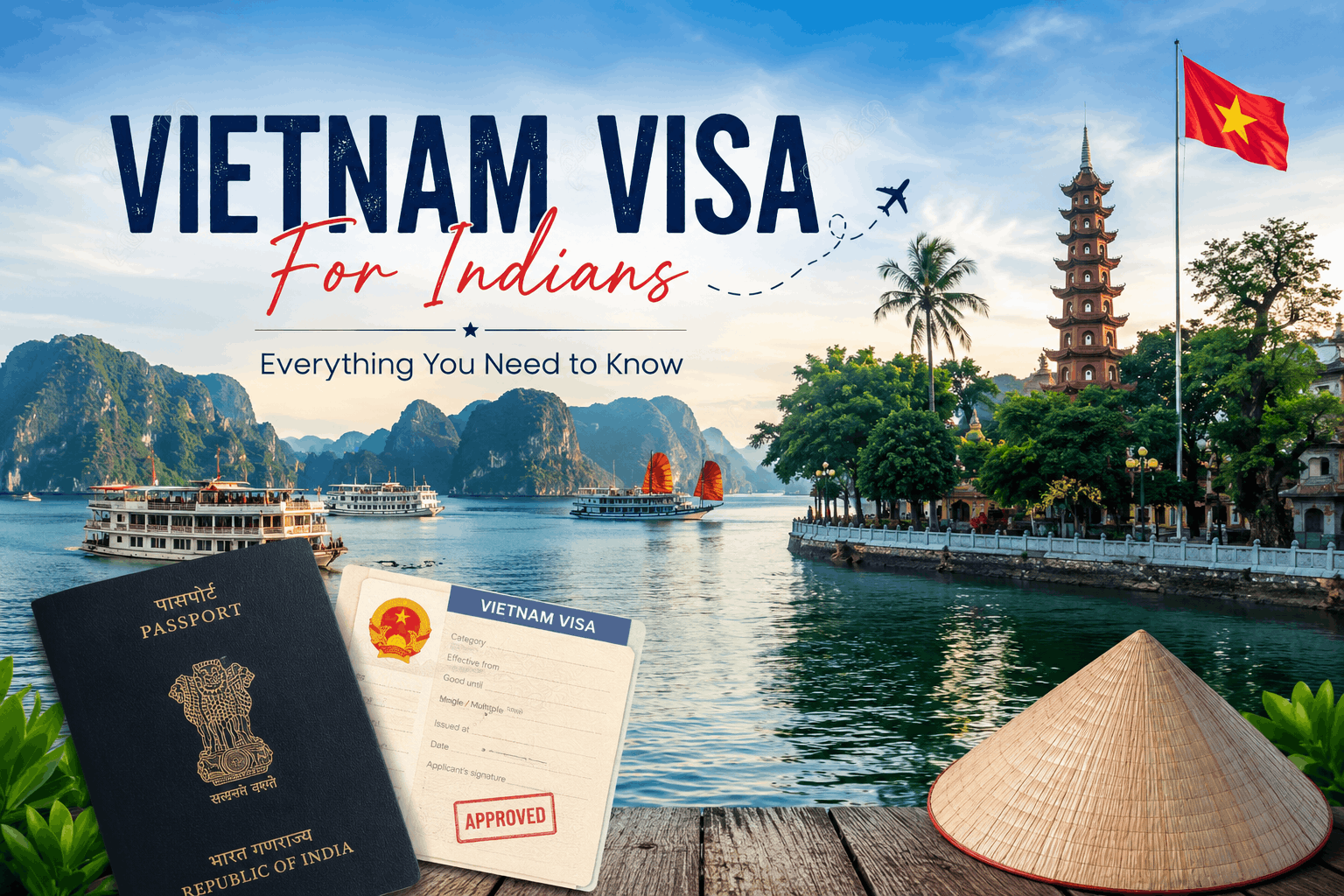
Planning a trip to Vietnam from India in 2026? Whether you want to explore Hanoi, cruise through Ha Long Bay, experience the lantern-lit streets of Hoi An or relax in Da Nang, understanding the Vietnam visa process is an important part of your travel planning.
For most Indian ordinary passport holders, the Vietnam e-Visa is the most convenient option for tourism. The application can be completed online through Vietnam’s official immigration portal without visiting an embassy for a standard tourist e-Visa application.
This guide explains the Vietnam visa requirements for Indians, e-Visa fees, eligibility, documents, application process, processing time, entry rules and common mistakes to avoid.
Do Indians Need a Visa for Vietnam in 2026?
Yes. Indian ordinary passport holders generally need a visa to enter Vietnam for tourism.
The most commonly used option is the Vietnam e-Visa, which is issued electronically by the Vietnam Immigration Department. The e-Visa can be issued for:
- Single entry
- Multiple entry
- A validity period of up to 90 days
Vietnam’s official immigration portal confirms that eligible foreign nationals can apply for an e-Visa directly online while outside Vietnam.
Important: Visa requirements can vary depending on passport type, nationality, purpose of travel and current immigration rules. This article is intended for Indian ordinary passport holders travelling for tourism.
What Is a Vietnam e-Visa?
A Vietnam e-Visa is an electronic travel authorization issued by the Vietnam Immigration Department. It allows eligible foreign travellers to enter Vietnam through approved immigration checkpoints.
The e-Visa is available for a maximum validity of 90 days and may be issued for either:
- Single entry: You can enter Vietnam once during the visa validity period.
- Multiple entry: You can enter and exit Vietnam multiple times during the visa validity period.
The approved e-Visa should be downloaded and printed before travel. Travellers may be asked to present it along with their passport at the airline check-in counter and immigration counter.
Vietnam e-Visa Fees for Indians in 2026
The official Vietnam e-Visa fees are:
| Visa Type | Government Fee |
|---|---|
| Single-entry e-Visa | US$25 |
| Multiple-entry e-Visa | US$50 |
The fee is paid online through the official payment gateway during the application process. The government fee is generally non-refundable, even if the application is refused or contains incorrect information.
Is There Any Additional Service Charge?
If you apply directly through the official portal, you generally pay the applicable government e-Visa fee. Travel agencies or visa service providers may charge an additional professional or processing fee for assistance with:
- Application form filling
- Document checking
- Photo and passport formatting
- Application submission
- Status tracking
- Correction support
Always confirm whether the quoted amount includes only the government fee or also includes service charges.
Vietnam e-Visa Validity and Stay Duration
Vietnam’s e-Visa can be issued for a maximum period of 90 days.
Depending on the visa issued, it may allow:
Single-Entry e-Visa
A single-entry e-Visa permits one entry into Vietnam. Once you exit Vietnam, the visa cannot normally be used again, even if the validity period has not expired.
Multiple-Entry e-Visa
A multiple-entry e-Visa allows eligible travellers to enter and exit Vietnam multiple times during the visa validity period.
For example, a traveller may visit Vietnam, travel to another country such as Thailand or Singapore and return to Vietnam during the validity of a multiple-entry e-Visa.
The exact validity dates and entry type will be mentioned on the approved e-Visa document.
Vietnam e-Visa Eligibility for Indian Passport Holders
Indian citizens can apply for a Vietnam e-Visa if they meet the applicable requirements.
Generally, applicants must:
- Be outside Vietnam when applying.
- Hold a valid passport.
- Provide accurate personal and passport information.
- Not fall under Vietnam’s prohibited-entry categories.
- Upload the required passport and photograph files.
- Pay the applicable e-Visa fee online.
Vietnam’s official immigration guidance states that applicants must be outside Vietnam, hold a valid passport and not fall under the legally restricted entry categories.
Documents Required for Vietnam e-Visa for Indians
The Vietnam e-Visa application is primarily online. You should keep the following documents and information ready before starting the application.
1. Valid Indian Passport
Your passport should be valid for more than six months from the relevant travel date.
Make sure:
- The passport is not damaged.
- Your name and date of birth are clearly visible.
- The passport has sufficient blank pages.
- The passport details match your flight booking and application form.
The passport information page must be uploaded during the application.
2. Passport-Size Photograph
You will need a recent digital photograph with:
- A clear front-facing view
- Neutral expression
- No sunglasses
- No headwear unless worn for religious reasons
- Plain or uncluttered background
- Good image quality
The official application instructions specify digital file requirements for the portrait photograph and passport data page.
3. Passport Biodata Page
Upload a clear scan or photograph of the passport page containing:
- Full name
- Passport number
- Date of birth
- Nationality
- Passport issue date
- Passport expiry date
- Photograph
- Machine-readable zone
Blurred, cropped or incomplete passport images may lead to delays or rejection.
4. Travel Details
Keep the following information available:
- Intended arrival date
- Intended departure date
- Port of entry
- Port of exit, if applicable
- Purpose of visit
- Accommodation details
- Planned address in Vietnam
You should select the correct entry checkpoint while completing the application.
5. Accommodation Details
You may need to provide the name and address of your hotel, resort, homestay or other accommodation in Vietnam.
If you are visiting multiple cities, you can generally provide the first accommodation address or the address requested by the application form.
6. Email Address
A valid email address is required for:
- Receiving application information
- Receiving payment-related notifications
- Tracking the application
- Accessing the approved e-Visa
Use an email account that you check regularly during the application period.
7. Payment Method
You need an accepted online payment method to pay the applicable e-Visa fee.
Before making payment, carefully verify all entered details because the fee is generally non-refundable.
Vietnam e-Visa Application Process for Indians
The application process is completed online through Vietnam’s official immigration website.
Step 1: Visit the Official Vietnam e-Visa Portal
Use the official Vietnam Immigration e-Visa website:
Vietnam Official e-Visa Portal
Vietnam’s Immigration Department announced that the e-Visa portal operates through the official domains evisa.gov.vn and thithucdientu.gov.vn.
Avoid unofficial websites that imitate the government portal or charge significantly higher fees without clearly explaining their service charges.
Step 2: Select the Individual Application Option
Choose the option for foreign nationals applying for an e-Visa while outside Vietnam.
The application is generally completed by the traveller directly, although an authorized service provider may assist with the submission.
Step 3: Upload Your Photograph and Passport
Upload:
- Passport biodata page
- Recent portrait photograph
Make sure the files meet the portal’s size and format requirements.
Step 4: Enter Your Personal Information
You will need to provide details such as:
- Full name exactly as shown in the passport
- Date of birth
- Nationality
- Passport number
- Passport issue and expiry dates
- Place of birth
- Email address
- Residential address
- Occupation details, where requested
Use the same spelling and sequence as shown in your passport.
Step 5: Enter Visa and Travel Details
Select:
- Single-entry or multiple-entry visa
- Proposed visa start date
- Intended duration
- Purpose of visit
- Entry checkpoint
- Accommodation details
The visa validity should cover your intended travel dates. Do not select dates randomly, as the approved visa will display specific validity dates.
Step 6: Review the Application Carefully
Before payment, check every detail, especially:
- Passport number
- Full name
- Date of birth
- Nationality
- Passport expiry date
- Visa type
- Entry date
- Entry checkpoint
- Email address
Incorrect information may result in the application not being accepted or may require a new application.
Step 7: Pay the e-Visa Fee
Pay the applicable fee online:
- US$25 for single entry
- US$50 for multiple entry
Save the payment confirmation and application registration code.
Step 8: Track the Application
Use the registration code, email address and other requested details to check the application status on the official portal.
Step 9: Download and Print the Approved e-Visa
If approved, download the e-Visa and print a copy.
It is advisable to carry:
- Printed e-Visa
- Digital copy on your phone
- Original passport
- Return or onward flight ticket
- Hotel confirmation
- Travel insurance, if purchased
- Basic itinerary details
The official instructions state that approved applicants should print the e-Visa for entry and exit from Vietnam.
Vietnam e-Visa Processing Time
The official Vietnam Immigration portal states that the standard processing time is approximately 3 working days after the application is completed and the required fee is paid.
However, processing may take longer if:
- The application contains incorrect information.
- The uploaded documents are unclear.
- Additional verification is required.
- There is a high volume of applications.
- Payment is unsuccessful or delayed.
- The applicant needs to correct the application.
When Should Indians Apply for a Vietnam e-Visa?
Although the official processing time is around three working days, it is better to apply at least 7–10 working days before travel.
For peak travel periods, festivals or international holidays, applying earlier is recommended. Do not wait until the day before your flight.
Vietnam e-Visa Entry Points
Vietnam e-Visa holders must enter and exit through an immigration checkpoint permitted for e-Visa travel.
Approved entry points may include selected:
- International airports
- Land border crossings
- Seaports
Before submitting the application, check that your intended airport or border checkpoint is listed as an eligible e-Visa entry point.
Common airports used by Indian tourists include:
- Noi Bai International Airport, Hanoi
- Tan Son Nhat International Airport, Ho Chi Minh City
- Da Nang International Airport
- Cam Ranh International Airport, Nha Trang
- Phu Quoc International Airport
- Cat Bi International Airport, Hai Phong
The permitted checkpoint list may change, so always verify the current list on the official immigration portal before applying.
Can Indians Get a Vietnam Visa on Arrival?
Vietnam does not operate the same simple airport Visa on Arrival system commonly associated with countries such as Indonesia.
For most Indian tourists, the practical option is to obtain a Vietnam e-Visa before travelling.
Some travellers may use other visa procedures involving an invitation, sponsorship or approval process, but these are different from the standard tourist e-Visa route.
You should not board a flight assuming that you can obtain a regular tourist visa at the Vietnamese airport without prior approval.
Vietnam Visa on Arrival vs e-Visa
| Feature | Vietnam e-Visa | Traditional Visa/Other Approval Route |
|---|---|---|
| Application | Online | May involve embassy, sponsor or authorized process |
| Suitable for | Most independent tourists | Special cases and specific travel purposes |
| Validity | Up to 90 days | Depends on visa issued |
| Entry | Single or multiple entry | Depends on approval |
| Processing | Generally around 3 working days | Varies |
| Airport collection | Not normally required | May be required depending on visa type |
| Government fee | US$25 or US$50 | Depends on category |
For a standard holiday, the e-Visa route is usually the most straightforward option for eligible Indian travellers.
Common Reasons for Vietnam e-Visa Delays or Rejection
A Vietnam e-Visa application may face delays or rejection due to:
Incorrect Passport Details
Even a small error in the passport number, name, date of birth or nationality can create problems.
Poor-Quality Uploads
Blurry passport scans, cropped images or unclear photographs may not be accepted.
Incorrect Entry Port
Selecting an incorrect or non-permitted entry checkpoint can cause issues during travel.
Wrong Visa Dates
Your visa start date should match your planned travel schedule. Applying for a visa with dates that do not cover your trip can create complications.
Incorrect Email Address
If the email address is wrong, you may not receive important application notifications or the approved visa.
Applying Through an Unofficial Website
Unofficial websites may charge extra fees or provide incorrect information. Always verify the domain before entering passport details or making payment.
Important Vietnam Visa Tips for Indian Travellers
Before travelling to Vietnam, keep these points in mind:
- Check your passport validity before applying.
- Enter your name exactly as it appears in your passport.
- Verify the selected entry airport or checkpoint.
- Apply well before your travel date.
- Save your registration code after submission.
- Print the approved e-Visa.
- Carry a digital backup of your visa.
- Keep return or onward flight details available.
- Carry hotel confirmation and a basic itinerary.
- Confirm that your e-Visa validity covers the complete trip.
- Do not rely on screenshots of an incomplete application.
- Recheck the official immigration portal before departure for any rule changes.
Frequently Asked Questions
Is Vietnam visa-free for Indians in 2026?
Generally, Indian ordinary passport holders need a visa for Vietnam. The Vietnam e-Visa is the commonly used option for tourism.
How much does a Vietnam e-Visa cost for Indians?
The official fee is US$25 for single entry and US$50 for multiple entry.
How long is the Vietnam e-Visa valid?
Vietnam e-Visas can be issued for a maximum validity of 90 days, depending on the visa approval.
How long does Vietnam e-Visa processing take?
The official standard processing time is approximately 3 working days, but applicants should allow additional time for delays or corrections.
Can I apply for a Vietnam e-Visa from India?
Yes. Eligible Indian citizens can apply online while outside Vietnam through the official immigration portal.
Do I need to visit the Vietnam Embassy for an e-Visa?
For a standard eligible e-Visa application, you generally do not need to visit the embassy. The process is completed online.
Can I enter Vietnam through any airport with an e-Visa?
No. You must enter through an immigration checkpoint permitted for Vietnam e-Visa entry. Check the approved list before submitting your application.
Is the Vietnam e-Visa fee refundable?
The official fee is generally non-refundable if the application is refused or the applicant is not eligible for entry.
Should I carry a printed Vietnam e-Visa?
Yes. Carry a printed copy along with the original passport. It is also sensible to keep a digital backup on your phone.
Can I extend my Vietnam e-Visa?
Visa extensions are subject to Vietnamese immigration rules and approval. Do not assume that an extension is automatic. If you plan to stay longer, verify the current procedure before travelling.
Final Checklist for Vietnam Travel from India
Before leaving for Vietnam, make sure you have:
- Valid Indian passport
- Approved Vietnam e-Visa
- Printed e-Visa copy
- Return or onward flight ticket
- Hotel confirmation
- Travel insurance, if applicable
- Basic travel itinerary
- Sufficient funds for the trip
- Digital copies of important documents
- Correct entry airport or checkpoint details
Plan Your Vietnam Holiday with Spark Holidays
Vietnam is ideal for couples, families, honeymooners and group travellers. From Hanoi and Ha Long Bay to Da Nang, Hoi An, Ho Chi Minh City and Phu Quoc, a well-planned itinerary can combine sightseeing, local experiences, comfortable hotels and smooth transfers.
Spark Holidays can assist with customized Vietnam holiday packages, flights, hotels, sightseeing, airport transfers, itinerary planning and visa assistance for Indian travellers.
Whether you are planning a short Vietnam getaway or a multi-city Southeast Asia holiday, professional planning can help you manage the travel arrangements more smoothly.